
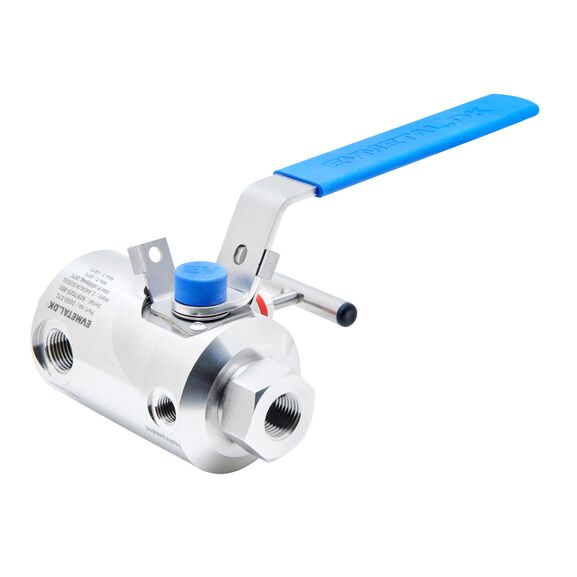
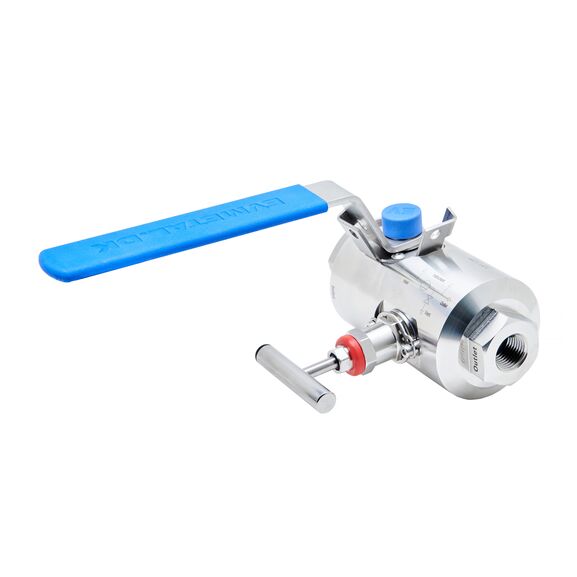


Bleed-Off-Manifold
Specifications
| Article number | Size | Ventilate | Tmin. | Tmax. | Material | MAWP | Instrument 1 & 2 | Inlet / Outlet | Orifice size |
|---|---|---|---|---|---|---|---|---|---|
| 1000-571 | 1/2" NPTF | 1/4" NPTF | -20 deg. C. | +130 deg, C. | AISI 316L | 6.500 Psig | 1/4" NPTF | 1/2" NPTF | 5,1 mm |
About the product
A bleed-off manifold (also known as a depressurization manifold) is a critical assembly of pipes and valves designed to relieve pressure from a system or wellbore in a controlled manner.
The valve is being used in relation to well interventions. The valve assembly
is used whenever bleed-off operation is conducted on any of the wellhead
casings or well intervention equipment.
The design eliminates the use of common “straight-line” fittings and
valve solutions that suffers from multiple leak points, operation
difficulties and the risk of breaking off.
The valve assembly comes with ½” BSP hose connections either end, a build-in
check valve and a large-and small-scale pressure gauge.
The design allows for installation in a 90deg bend or straight and gives good
control during bleed off operation as pressures can be followed all the way
down to 0 due to the range of the two pressure gauges.
At the same time the check valve ensure no return and the
ball valve allow for quick response while the needle valve allow for
control of the flow.
Please Note! Optional model with integrated check valve, is available.
Here is how it is used on the platform:
Controlled Depressurization: After high-pressure tests or treatments, the pressure in lines must be bled off safely to prevent sudden "shock forces" that can damage equipment or endanger personnel.
Maintenance Isolation: Using a "block and bleed" setup, we close the main isolation valves (block) and use the manifold to drain the remaining fluid or gas (bleed). This ensures a safe working environment for repairing downstream components like pumps or sensors.
Well Control (Lubricate and Bleed): During well intervention, if you can't circulate fluids, you can use this manifold to remove gas pockets. You repeatedly pump in Kill mud and then "bleed off" the excess gas pressure until the well is stabilized.
Safe Fluid Handling: The manifold is designed to capture and route liquids or gases to a dedicated disposal system, such as a separator or flare, to avoid environmental spills or hazardous venting on deck.
For maximum reliability in harsh offshore environments, these manifolds are typically constructed from high-strength, corrosion-resistant materials like Super Duplex.