
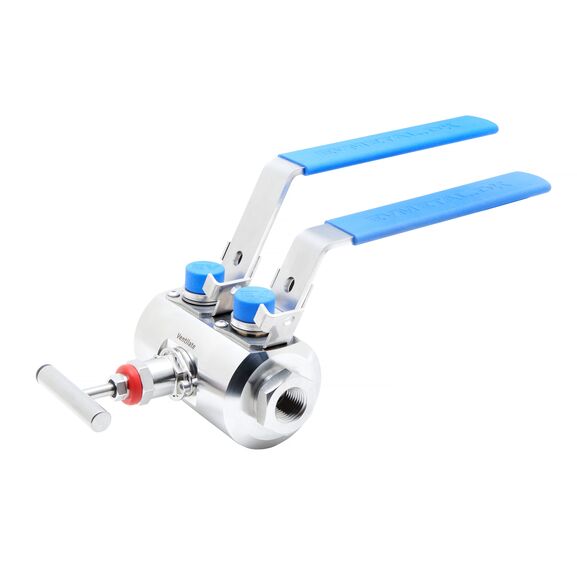

Double Block & Bleed Valve (DBB)
Specifications
| Article number | Size | Inlet | Outlet | Ventilate | Tmin | Tmax. | MAWP | Material | Standard |
|---|---|---|---|---|---|---|---|---|---|
| 1000-801 | 1/2" | 1/2" NPTF | 1/2" NPTF | 1/4" NPTF | -29 deg. C. | +121 deg. C. | 6.500 Psig | AISI316L | ASME B1.20.1 |
About the product
A Double Block and Bleed (DBB) ball valve is a single-unit solution designed to provide high-integrity isolation in a piping system.
Instead of relying on two separate ball valves, a DBB valve integrates two seating surfaces and a vent point into one body.
in other words a Double Block and Bleed (DBB) ball valve is in fact a "three-in-one" safety solution. It replaces what used to be a complex arrangement of separate valves and piping with a single, high-integrity unit.
Design Principles
The core goal of a DBB valve is to provide a verifiable seal between two high-pressure sections of a system.
Integrated Manifold: Instead of three separate valves, a DBB unit houses two seating surfaces (the "Blocks") and a small vent valve (the "Bleed") in one body. This reduces weight and minimizes potential leak points (flanges).
Dual Sealing: In a single-ball DBB design, the ball has two independent seats. According to API 6D, the valve must be able to seal against pressure from both ends simultaneously.
The Bleed Function: Between the two main seals, there is a cavity with a small needle or ball valve. This is the "tell-tale." When the two main blocks are closed, you open the bleed. If the flow stops, you have proven that the seals are holding, and the downstream side is safe to work on.
Self-Relieving Seats: Most DBB designs feature seats that automatically vent excess cavity pressure back into the pipeline if it gets too high (usually due to thermal expansion).
more in detail...
Strategic Installation Points
On an offshore platform, DBB ball valves are installed wherever positive isolation is mandatory for safety or maintenance.
Instrument Isolation: This is the most common use. We install small-bore DBB valves before pressure gauges and transmitters so they can be removed or calibrated without shutting down the entire flow line.
Pig Launchers and Receivers: To safely open a pig trap, you must be 100% certain the high-pressure main line is blocked. A DBB valve provides that verified barrier.
Chemical Injection Lines: We use them at the point where chemicals (like methanol or scale inhibitors) enter the process stream to prevent high-pressure hydrocarbons from backing up into the injection pumps.
Sampling Points: When taking a live fluid sample, a DBB setup ensures the technician can bleed off the pressure in the sample line before disconnecting.
High-Pressure Manifolds: Used to isolate specific production headers during maintenance while the rest of the platform remains online.
Why are they used?
Positive Isolation: It blocks pressure from both the upstream and downstream sides of the valve simultaneously.
Seal Verification: By opening the "bleed" (vent) in the center cavity, we can prove the integrity of the seals. If no fluid escapes the bleed, we know the seats are holding 100%.
Space and Weight Savings: It replaces the traditional "two valves and a spool" setup, which is critical on offshore platforms where space is at a premium.
Safety: It allows us to drain or vent the cavity pressure, ensuring the downstream line is safe for maintenance or inspection without the risk of product bypass.
A Double Block and Bleed (DBB) ball valve provides, in a single compact unit, positive, verifiable isolation by utilizing two independent seating surfaces (blocks) and a central vent/drain port (bleed) to safely remove trapped pressure between them. It is critical on platforms for isolating high-pressure pipelines, pig launchers, gas metering skids, and subsea manifolds.
Design Features of a DBB Ball Valve
Dual-Seal Mechanism: The valve features two separate, independent seats that create a positive seal on both the upstream and downstream sides of the ball.
Bleed System: A small drain or vent valve (needle or ball valve) is positioned in the cavity between the two main seats. This allows operators to drain trapped fluid or pressure, proving that the primary seals are holding.
Single-Ball/Double-Seat vs. Dual-Ball: While some use a single ball with two seats, high-integrity models often use two separate balls, each with its own seats and stem, for maximum redundancy.
Self-Relieving Seats: Usually designed with unidirectional, self-relieving seats that allow cavity pressure to bleed into the pipeline, preventing over-pressurization.
Safety Features: Often equipped with anti-static, anti-blowout stems, and fire-safe designs.
Applications on Oil & Gas Platforms
Pipeline Isolation: Installed for main process line isolation, especially when conducting "hot work" or maintenance without a full system shutdown.
Gas Metering Skids: Essential for isolating custody transfer meters during calibration or maintenance.
Pressure Instrument Protection: Used to isolate pressure transmitters or gauges, allowing them to be replaced while the system is pressurized.
Subsea Manifolds: Used in offshore, weight-sensitive areas where compact, reliable isolation is required.
Pig Launcher/Receiver Systems: Used to isolate the launcher while it is being loaded or unloaded, preventing hydrocarbons from entering the trap.
Why Use a DBB Ball Valve?
Increased Safety: Eliminates the risk of residual pressure or hazardous fluids leaking during maintenance.
Space & Weight Reduction: Replaces multiple individual valves with one unit, reducing weight by up to 75%.
Reduced Maintenance Time: Facilitates faster, safer, and easier valve maintenance and repair procedures