
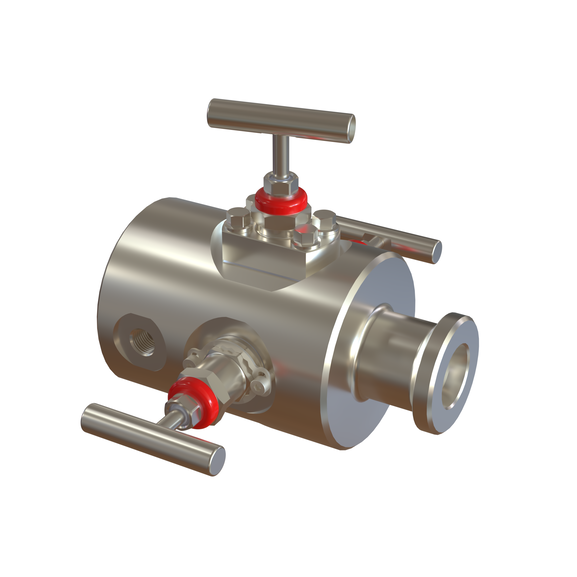
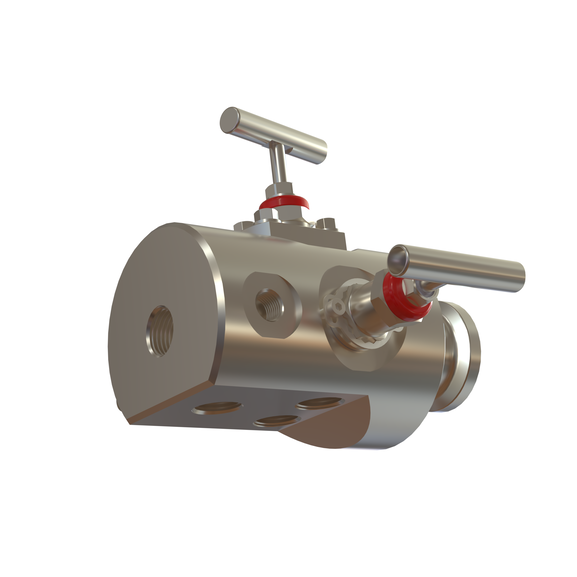
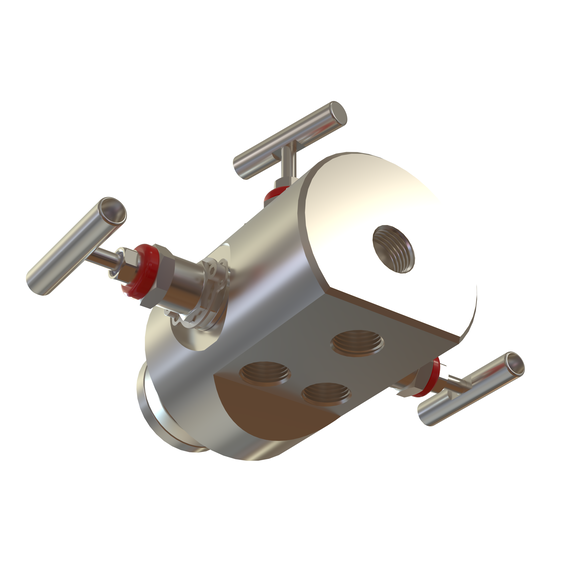


DBB Manifold with Graylok® HUB, Triple outlet.
Specifications
| Article number | Size | Inlet | Ventilate | tMin. | tMax: | Max. Pressure | Material | Outlet 1 | Outlet 2 | Outlet 3 | Gauge |
|---|---|---|---|---|---|---|---|---|---|---|---|
| 1000-802 | 1/2" | 1GR7 HUB | 1/2"-14 NPTF | -29 deg. C. | +130 deg. C. | 10.000 Psig | Super Duplex | 1/2"-14 NPTF | 1/2"-14 NPTF | 1/4"-18 NPTF | 1/2"-14 NPTF |
About the product
Double Block & Bleed Manifold (DBB) with Graylok® 1GR7 HUB end and triple outlet.
A Double Block and Bleed (DBB) valve manifold is a critical safety assembly used to achieve positive isolation of high-pressure or hazardous process fluids on an offshore platform. It essentially replaces a complex "spool piece" of three separate valves with a single, integrated unit.
Here is why our clients use them in offshore operations:
1. Enhanced Safety & Positive Isolation
The core purpose is to provide a redundant safety barrier. The manifold consists of two independent block valves (the "Double Block") and a central bleed valve.
Dual Barriers: If the primary upstream valve leaks, the second valve acts as a backup to prevent the medium from reaching the downstream work area.
Safe Bleeding: The "bleed" valve in the middle vents any trapped pressure or leakage to a safe location (flare or drain), creating a "zero-energy zone" for maintenance teams.
2. Critical Weight and Space Savings
On a platform, every square meter and kilogram matters.
Integrated Design: Traditional isolation setups involve heavy piping and multiple flanged connections. A DBB manifold integrates these into one forged body, reducing weight by up to 75% and significantly shrinking the footprint.
Fewer Leak Points/Leak Paths: By eliminating various flanged joints and welding points, you drastically reduce the potential for hydrocarbon leaks into the atmosphere which is major safety priority offshore.
3. Seat Integrity Verification
The bleed valve serves as a diagnostic tool. Once both block valves are closed, opening the bleed allows you to verify if either seat is leaking. If the bleed continues to flow, it tells you that the isolation is not 100% tight, allowing one to address the issue before a technician starts work on the line.
4. Instrument Isolation & Calibration
Offshore technicians often use smaller DBB manifolds (like monoflanges) to isolate pressure transmitters and gauges. This allows you to remove or calibrate an instrument while the main process remains live, avoiding costly production shutdowns.