
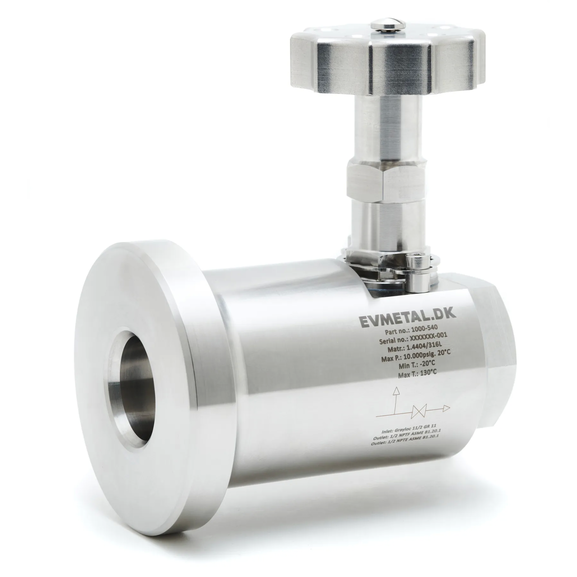

Fire Safety Valve, single Block
Specifications
| Design Pressure: | Inlet: | Outlet 1&2: | Design temperature | Valve bore: | Article number: | Size: |
|---|---|---|---|---|---|---|
| 10.000 Psig | Grayloc® 11/2" GR 11 | 1/2"NPTF | -29°C/+130°C | 5,1 mm | 1000-540 | 1/2" |
About the product
Type:
Single block needle valve with non-rotating tip.
Antistatic design according to EN 12266-2 F21 and F22.
Design standards:
PED, ASME B16.34, API 6A, API6D, according to customer specifications.
Design pressure: 10.000 psig.
Design temperature: -29°C to +130°C.
Inlet connection: Grayloc or similar according to customer specifications.
Outlet connections: Threaded according to customer specifications.
Operation: Round handle Ø50mm or Ø70mm (optional)
Materials (according to customer specifications):
Austenitic stainless steel type 316.
Ferritic/Austenitic stainless steel type 22Cr (Duplex).
Ferritic/Austenitic stainless steel type 25Cr (Super Duplex).
High alloy austenitic stainless steel type 6Mo (optional).
What is the manifold used for?
The manifold is mounted on the X-tree for hydraulic tie from the WHCP to operate the SSSV.
With the unique design, the manifold can be used on all X-tree brands. The manifold will be equipped with a port connection for a fusible plug
In the unlucky event of fire and closed manifold valve, the fusible plug will release the pressure for SSSV and obtain the high safety level.
Please note: Fusible plug is available upon request.
Please note: Dimensions and type of valve ends can be changed according to customer specifications.
As a valve manufacturer, we define a metal-seated wellhead fire safety valve as a critical isolation component specifically designed to maintain pressure containment and seal integrity under extreme heat conditions (e.g., in a fire) where standard soft-seated (polymer/plastic) seals would melt and fail.
These valves are primarily used on wellheads, production trees, and associated flowlines to prevent uncontrolled releases of flammable oil and gas, thereby protecting life, equipment, and the environment.
Here is a detailed breakdown of what they are used for:
1. Primary Purpose: Fire-Safe Containment
The "Metal-to-Metal" Guarantee: Unlike regular valves that rely on PTFE or elastomers for a bubble-tight seal, these valves use precision-lapped metal seats (e.g., stainless steel, stellite). If a fire burns away the soft, secondary seals, the metal-to-metal contact prevents the valve from leaking, even if the primary seal is compromised.
Preventing Catastrophic Failure: In offshore rigs and processing plants, fire safety valves are essential to stop the fuel supply (oil/gas) from feeding a fire, preventing a minor emergency from becoming a catastrophic explosion.
Standard Compliance: These valves are designed to pass rigorous API 6FA, API 607, or ISO 10497 fire testing standards, confirming they can withstand 30 minutes of high-temperature exposure.
2. Harsh Environment & Severe Service
Metal-seated fire safety valves are used where the operating environment would instantly destroy a soft-seated valve:
High Temperatures: They can handle process temperatures well over 500°C (932°F).
Abrasive/Dirty Media: The metal seats are hardened to resist erosion from sand, grit, or solid particles often found in produced fluids.
High Pressures: They are robust enough to withstand the high-pressure conditions typically found at the wellhead.
3. Key Applications
Wellhead Emergency Shutdown (ESD): Used in oil and gas production, refineries, and petrochemical plants to isolate production lines, manifolds, and storage tanks.
Production Trees (Christmas Trees): Acting as the primary barrier on the wellhead to ensure that if a fire occurs, the well can be shut in securely.
Refinery Piping: Any application where flammable fluids are handled, and a reliable shut-off is required under extreme, high-risk, or high-temperature conditions.
4. Why We Choose Metal Seated over Soft Seated
While soft-seated valves (like PTFE) provide "bubble-tight" sealing during normal operation, they fail in fire conditions. Metal-seated valves, though potentially allowing minor leakage according to API standards, remain structurally sound during a fire.
In summary: A metal-seated wellhead fire safety valve is your last line of defense, ensuring that in the event of a fire, the valve stays closed to prevent the spread of dangerous, flammable materials.